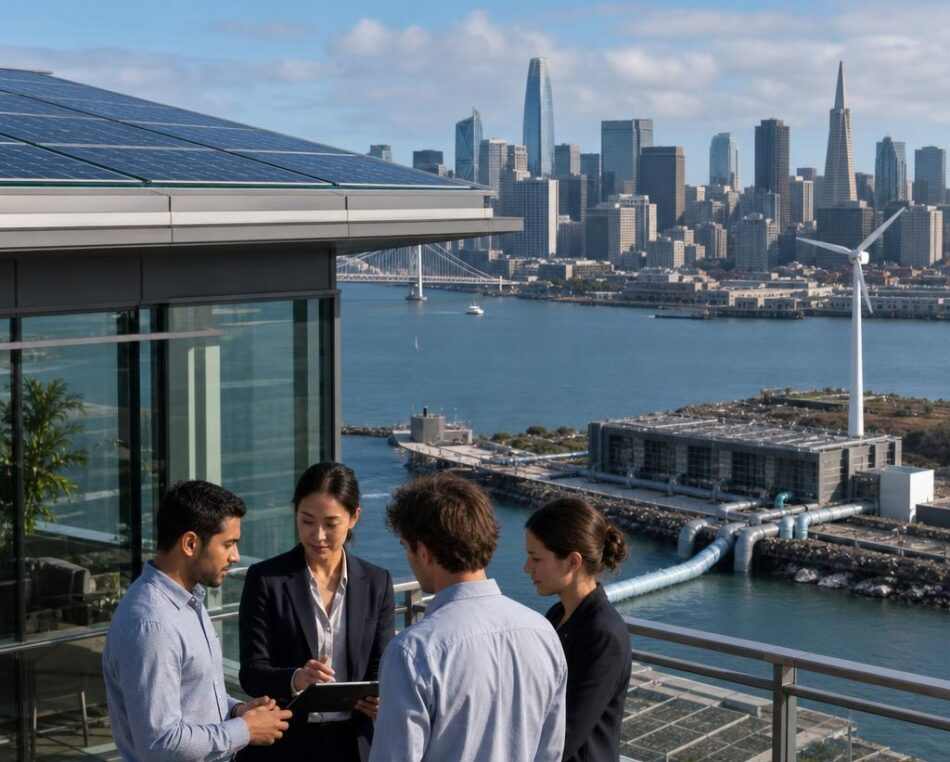
In February 2026, San Francisco startups attracted more than $33.9 billion in venture capital funding-representing 54.2% of all U.S. startup investment for the month, according to San Francisco city data and market reports. The broader Bay Area, including California hubs like Mountain View, commanded nearly $50.5 billion, or 80.8% of the national total. Crucially, much of this capital is flowing into AI-enabled Clean Technology and Climate Tech ventures, fueling a new era of sustainable innovation. As climate urgency accelerates, San Francisco’s ecosystem is a magnet for global founders and investors seeking high-impact, scalable solutions. For the latest trends and advisory insights, the Damalion blog offers deep dives into sector developments.
San Francisco’s CleanTech landscape benefits from its proximity to world-class research universities, a sophisticated investor base, and forward-thinking policy frameworks. Notably, the Bay Area Air Quality Management District’s (BAAQMD) Climate Tech Finance program has catalyzed clean project lending, with a pipeline approaching $50 million and expected annual emissions reductions nearing half a million metric tonnes CO₂e within five years. This combination of public and private initiative-alongside dedicated funds and megadeals in AI-creates fertile ground for breakthrough technologies in renewable energy, carbon capture, and green infrastructure. Damalion supports CleanTech founders entering the U.S. market with corporate structuring, Inflation Reduction Act (IRA) incentive optimization, and ESG compliance advisory, bridging international ambition with local expertise.
AI-Driven Climate Resilience: ClimateAI’s Global Impact
Founded in 2017 by Himanshu Gupta and Max Evans, ClimateAI exemplifies San Francisco’s leadership in AI-powered climate risk management. The company’s flagship SaaS platform, ClimateLens, leverages patented AI models to deliver hyper-localized climate resilience forecasting for agricultural and water supply chains worldwide. ClimateAI’s solutions are trusted by over 30 enterprise and government clients-including Dole, Driscoll’s, and Oatly-spanning 35 countries and generating approximately $9 million in annual revenue.
Having raised $22 million in Series B funding in April 2023 (led by Four Rivers Group with participation from Sequoia Capital, Intel Capital, and others), ClimateAI’s total capital now stands at roughly $34 million. The company’s patented approach enables corporations to map climate volatility, mitigate supply chain risks, and unlock new value from sustainability-driven operations. For investors, ClimateAI’s traction and international client base signal the scalability and global relevance of AI-driven climate tech emerging from San Francisco.
Nature-Based Solutions and Carbon Markets: Earthshot Labs
Another remarkable player, Earthshot Labs, operates the Earthshot Carbon Development Platform and the LandOS analytics suite. With chief scientist Trevor Keenan among its leadership, Earthshot Labs focuses on automating feasibility analysis and underwriting for nature-based carbon projects. The platform has facilitated over 60 reforestation, conservation, agro-forestry, and improved forest management initiatives globally-directing more than $55 million in financing and supporting projects spanning over one million hectares. These undertakings are projected to sequester more than 30 million tonnes of CO₂, underscoring the potential for nature-based carbon removal at scale.
In July 2024, Earthshot Labs raised a $5.5 million Series A round led by Acorn Pacific Ventures, with support from Earth Foundry, Future Ventures, Resilient Earth Capital, and others. Strategic partners include BirdLife International and TreeAid, highlighting the company’s credibility and impact across the voluntary carbon market. As regulatory demands for ESG compliance increase, Earthshot Labs’ automated diligence and project development capabilities offer a critical tool for multinationals, project financiers, and climate-conscious investors alike.
Innovative Infrastructure: NetworkOcean’s Underwater Data Centers
Infrastructure innovation remains a hallmark of San Francisco’s CleanTech ecosystem. NetworkOcean, co-founded by Sam Mendel (CEO) and Eric Kim (CTO), is pioneering underwater data centers cooled by seawater-a breakthrough that eliminates freshwater usage and slashes power consumption by up to 30%. NetworkOcean’s near-shore capsules, positioned close to San Francisco, offer low-latency GPU compute for the AI and cloud economy while reducing land and infrastructure costs. The startup claims to save more than 10 billion gallons of freshwater annually, making it a standout in sustainable digital infrastructure.
Having completed a $500,000 seed round in June 2024 (led by Y Combinator and backed by Pioneer Fund), NetworkOcean exemplifies the intersection of climate innovation, advanced computing, and resource efficiency. As data center energy demand soars worldwide, solutions like NetworkOcean’s address both environmental and business imperatives-drawing investor attention in the region.
Capital, Regulatory Support, and Global Opportunity
The scale of venture investment in San Francisco is matched by robust regulatory and ecosystem support. The BAAQMD’s Climate Tech Finance program has already mobilized millions in loans for early-stage projects, leveraging each dollar of public capital to attract up to $10 in private sector funding. Early project cohorts are expected to reduce nearly 30,000 metric tonnes CO₂e in the first year alone, with a five-year target of nearly 500,000 metric tonnes annually. This public-private synergy accelerates commercialization and de-risks innovation for investors.
International founders and investors can also tap into a world-class network of accelerators, research institutions, and cross-sector partnerships. San Francisco’s connectivity to global markets-bolstered by its leadership in AI, fintech, and sustainability-makes it a launchpad for climate solutions with worldwide relevance. For a deeper look at related trends, see Damalion’s coverage of San Francisco’s Clean Technology & Climate Tech Ecosystem and the San Francisco Robotics & Automation Startups landscape.
Damalion supports international startups (from pre-seed, seed, series, A, B, C, growth stage and mid-caps) entering the U.S. market with corporate structuring, fundraise, customer development expertise, regulatory compliance, and operational guidance tailored to the needs of growing companies. We also advise international investors, family offices navigating the U.S. startup ecosystem and real estates with deal sourcing and strategic advisory.