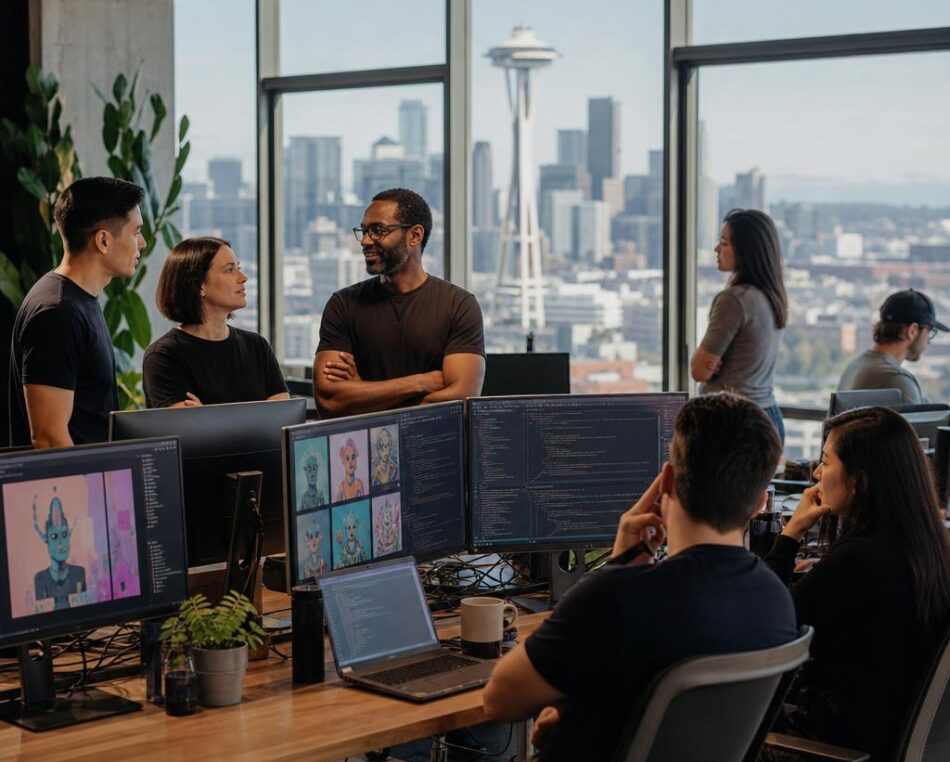
Seattle, Washington, continues to strengthen its position as a serious U.S. Web3 and blockchain hub in 2026. The city’s profile rose sharply after Eigen Labs, the Seattle-based team behind EigenLayer, secured a landmark $100 million Series B round from a16z crypto in February 2024. That transaction became one of the region’s strongest signals of institutional confidence in blockchain infrastructure, restaking, Ethereum security, and decentralized finance.
Despite the global crypto funding correction that followed the 2021–2022 cycle, Washington’s blockchain ecosystem remains active. The 2024 Washington State Blockchain Report identified more than $797 million in Web3-related investments across the state, including $369.36 million in early-stage venture capital. In parallel, the broader U.S. crypto and blockchain venture market moved from a 2023 downturn into a more selective 2024–2026 funding cycle, with investors prioritizing infrastructure, stablecoins, tokenization, compliance, custody, and institutional-grade digital asset platforms.
For international investors, founders, family offices, and venture capital funds, Seattle offers a practical entry point into the U.S. blockchain market. Its cloud computing expertise, enterprise software talent, cybersecurity depth, and proximity to major technology companies make it attractive for Web3 companies that want to build more than speculative tokens. The region’s startups are increasingly focused on compliant stablecoin infrastructure, Bitcoin-native marketplaces, Web3 growth platforms, and tokenized asset systems designed for institutional adoption.
For advisory on U.S. regulatory structuring, SEC/CFTC compliance, stablecoin frameworks, token issuance, and market-entry strategy, see the Damalion global insights hub.
Next-Generation Web3 Startups in Seattle: Infrastructure, Trading, and Growth
Eigen Labs remains the most visible Seattle blockchain infrastructure company. Its EigenLayer protocol helped popularize the concept of Ethereum restaking, allowing crypto-economic security to be reused across additional networks and decentralized services. The company’s $100 million Series B round from a16z crypto in February 2024 gave Seattle a major Web3 reference transaction and reinforced investor appetite for infrastructure projects that serve the wider Ethereum ecosystem.
Stably is a venture-backed fintech founded by Kory Hoang and David Zhang. The company provides stablecoin and fiat on-ramp infrastructure for Web3 applications, financial institutions, and digital asset platforms. Its model is especially relevant in 2026 as stablecoins become increasingly important for cross-border payments, tokenized finance, treasury settlement, and DeFi liquidity. Following the development of a more formal U.S. stablecoin regulatory framework, compliance-first stablecoin platforms are better positioned to serve institutional users.
Satflow is building trading infrastructure for Bitcoin-based digital assets, including Ordinals and Runes. The company raised a seed round in 2024 to develop a professional trading experience for Bitcoin tokens and NFTs. Its focus on Bitcoin-native assets, real-time market activity, and trader-oriented tools shows how Seattle-linked Web3 innovation is expanding beyond Ethereum and Solana into differentiated Bitcoin infrastructure.
Genzio Media, founded in 2021, operates as a Web3 marketing ecosystem and incubator. Serving blockchain and emerging technology brands, Genzio helps projects improve market visibility, community development, and adoption. Specialist agencies such as Genzio reinforce Seattle’s role not only as a product development center, but also as a launchpad for Web3 brands seeking U.S. and global market access.
Asensys, historically associated with blockchain network security and led by Brendon Wang, is now deadpooled. However, its earlier $2.7 million angel round in 2020 remains part of Seattle’s blockchain legacy, reflecting the region’s early technical interest in scalability, distributed systems, and blockchain security.
Venture Funding: From Crypto Winter to Selective Recovery
Seattle’s Web3 market should be viewed through the lens of a more selective 2026 funding environment. The easy-money era of speculative token launches has passed. Investors now focus on infrastructure, compliance, stablecoins, custody, AI-blockchain intersections, tokenized real-world assets, payment rails, and platforms that can generate real institutional demand.
The Washington State Blockchain Report identified $797 million in Web3 investments across more than 61 companies, with early-stage venture capital representing $369.36 million. These figures show that the state has built a meaningful base of blockchain company formation and investor participation, even if deal activity remains more concentrated than in larger hubs such as New York, San Francisco, or Miami.
Globally, crypto venture capital recovered from the 2023 downturn but remained disciplined. In 2024, venture capitalists invested approximately $11.5 billion into crypto and blockchain startups across more than 2,000 deals. By 2025 and 2026, capital continued to favor stronger teams, clearer revenue models, regulated infrastructure, and projects aligned with institutional digital asset adoption.
For investors and family offices, Seattle offers a blend of enterprise talent, technical credibility, cloud infrastructure, and regulatory awareness. The city is not simply a speculative Web3 market; it is better understood as an infrastructure-driven ecosystem where blockchain companies can build tools for finance, payments, tokenized assets, and decentralized networks.
For a private equity perspective on local dealmaking, see the recent analysis in Seattle Private Equity: LBO, Growth Capital & Exits—2026 Investor Playbook.
Regulatory Climate: Stablecoins, Tokenization, and SEC/CFTC Compliance
By 2026, U.S. digital asset regulation has become more structured, although still complex. Stablecoin issuers, token platforms, DeFi protocols, NFT marketplaces, and crypto trading businesses must assess securities law, commodities regulation, money transmission rules, AML/CFT obligations, sanctions screening, custody requirements, consumer protection, and state-level licensing.
The 2025 GENIUS Act created a federal framework for payment stablecoins, including reserve-backing and disclosure requirements. This development is highly relevant for Seattle companies such as Stably and for international founders planning to issue or distribute stablecoin-related products in the United States.
In 2026, SEC and CFTC coordination has also become more important. New interpretive and policy developments are aimed at clarifying how certain crypto assets should be treated under U.S. securities and commodities laws. This does not eliminate legal risk. Instead, it increases the need for careful structuring before launching token offerings, staking products, DeFi interfaces, exchange functionality, or tokenized securities.
Seattle’s Web3 founders are therefore building in a market where compliance is no longer optional. Companies that integrate legal architecture, investor disclosures, custody safeguards, AML controls, and jurisdictional analysis from the beginning are better positioned to attract institutional capital.
Damalion facilitates advisory for Web3 companies on U.S. corporate structuring, SEC/CFTC compliance, token issuance frameworks, stablecoin structuring, investor onboarding, and operational best practices. This support is particularly relevant for international founders, venture-backed startups, and family offices seeking compliant exposure to U.S. blockchain and digital asset markets.
For a closer look at how legaltech and contract innovation are shaping local Web3 compliance, visit Seattle’s LegalTech Startup Ecosystem: AI, Compliance, and Contract Innovation in the Emerald City.
Seattle’s Position in the U.S. Web3 Landscape in 2026
Seattle’s blockchain strengths come from its deep enterprise software roots, cloud infrastructure, cybersecurity expertise, engineering talent, and proximity to major technology platforms. Unlike markets driven mainly by crypto trading speculation, Seattle’s Web3 ecosystem is increasingly focused on scalable infrastructure, regulatory discipline, and enterprise-grade use cases.
This positioning matters in 2026. The next phase of blockchain growth is likely to be shaped by stablecoins, tokenized real-world assets, Bitcoin-native applications, Ethereum infrastructure, institutional custody, compliant DeFi, and AI-enhanced financial automation. Seattle has the talent base and technical culture to compete in these categories.
For international investors, founders, family offices, and venture capital funds, Seattle offers a high-quality U.S. base for blockchain expansion. Whether launching a stablecoin infrastructure platform, developing Bitcoin NFT and token marketplaces, building Web3 compliance tools, or supporting tokenized asset strategies, the city provides a strong combination of engineering depth and regulatory seriousness.
Damalion supports international startups from pre-seed, seed, Series A, Series B, Series C, growth stage, and mid-cap level entering the U.S. market with corporate structuring, fundraising preparation, customer development expertise, regulatory compliance, and operational guidance tailored to the needs of growing companies. Damalion also advises international investors and family offices navigating the U.S. startup ecosystem, digital assets, private equity, and real estate opportunities through deal sourcing and strategic advisory.